
2020 Mero Sathi Project


Self-Reflection
The theme of this year's Seki seminar is " Self-reflection through interactions with diverse others ." Students are researching how their past and experiences have influenced their present selves.

What is self-reflection?
←Click here for the flow of activities over the year

Self-reflection involves objectively looking at past experiences and the emotions you felt at the time in relation to your personality and values.
There are many factors that shape a person, such as differences in country and culture, and family environment.
Even for me, it's difficult to figure it all out.
Through self-reflection, you may also be able to see aspects of yourself that you hadn't noticed before.
there is.
This activity is about what kind of environment and people you want in life.
I want to understand my strengths and make the right choices.
Not only understanding the current situation,
You will gain the skills you need to enrich your life going forward.
In the first semester, students in the Seki seminar were divided into groups to hold discussions and discuss their own lives.
I dug deeper.
Based on the discussion, each participant created and watched a 15-minute video reflecting on their life.
The videos were also unique, sometimes making you laugh and sometimes bringing tears to your eyes.
I don't think there are many opportunities in life to think about " who I am, " so
This was a very insightful activity for the seminar students.


Fumbling self-reflection,
Professor Seki doesn't know the answer either...!?
Have you ever heard the term " self-reflection " in your life?
What do most students who join the Seki seminar actually do and what do they learn?
I didn't understand.
But it's not just us,
Even Professor Seki didn't know how to do it.
Prologue


In this situation, Professor Seki introduced one method.
I came up with the idea.
The method was to create a video looking back on one's life, have seminar students watch it, and then dig deeper into the things that concerned them and the things they realized about themselves by comparing it with the lives of others .
After hearing about the activities, none of us knew the correct answer, so we decided to steer the continuing students towards a trial-and-error self-reflection activity.
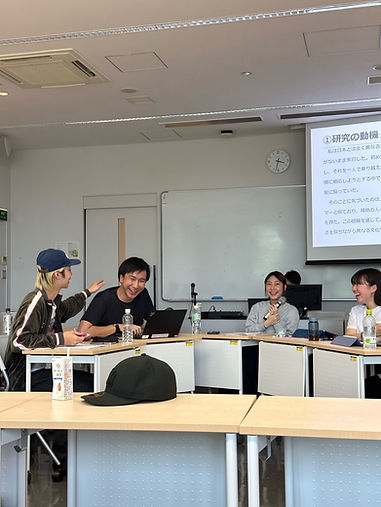
Led by Zenta, who was appointed leader of the self-reflection group, Mimi, Kun, Miyu, and Mio, who are continuing students from last year and have a wide range of experience including studying abroad and AAEE activities , held late-night meetings to discuss how to proceed.
Even though I didn't understand it, focusing on one person's life and combining self-reflection with the objective opinions and questions of others took more time than I had imagined, and I felt daunted when I first started...

There are some important things to keep in mind when engaging in smooth self-reflection.
It's the relationships between the members who work together .
Before you can understand others, you need to face and understand yourself and express that understanding.
Only when people have trust can they bring up personal topics, and the other person is able to respond to those concerns.
To fulfill this condition, we first split into small groups and went out to eat, or after the seminar we chatted over sweets to get to know each other better.
After several interactions, each person created a life reflection sheet, and we used this to delve deeper into and consider the person.
Self-reflection is as unique to each individual, and of course, you cannot get to the heart of each person in the same way.
We spent dozens of hours discussing the project, and the 15-minute video that followed took even longer to complete!
